
Waffle Game New York Times is a daily word puzzle that challenges players to rearrange scrambled letters into correct words within a limited number of moves. It is designed in a unique grid format where every letter must fit perfectly both horizontally and vertically, making it more strategic than typical guessing games.
Unlike other simple word puzzles, the Waffle game focuses on logic, pattern recognition, and careful planning. Each move has an impact on the final solution, which makes the game both engaging and mentally stimulating for players who enjoy structured problem-solving and vocabulary challenges.
What is the Waffle Game by NYT?
Waffle Game New York Times is a daily word puzzle that challenges players to rearrange scrambled letters into correct words within a waffle-shaped grid. Unlike traditional guessing games, it requires solving multiple horizontal and vertical words at the same time using a limited number of swaps. Each letter is already placed in the grid but in incorrect positions, and players must strategically move them to complete the puzzle. The game emphasizes logic, vocabulary, and pattern recognition, making it both educational and entertaining. It is part of the broader NYT Games collection designed for puzzle enthusiasts’ daily challenge.
Overview of the Waffle Puzzle Concept
The Waffle puzzle concept is built around a unique word grid where letters are already provided but placed in incorrect positions. Players are required to rearrange these letters by swapping them until all horizontal and vertical words become correct. Unlike simple word guessing games, Waffle focuses more on structure, pattern recognition, and logical thinking rather than just vocabulary knowledge. Each puzzle is designed in a compact grid format that resembles a waffle shape, which makes it visually distinctive and easy to recognize. The main challenge lies in figuring out how each letter connects with others across both directions, making every move meaningful and strategic for solving the entire puzzle successfully within limited attempts.
In addition to its structure, the Waffle puzzle encourages players to think several steps ahead before making any move. Since every swap affects two words at once, players must carefully analyze the entire grid instead of focusing on a single word. This interconnected design increases the difficulty level while also making the gameplay more engaging. The puzzle also provides subtle feedback through letter positioning, helping players gradually move closer to the correct solution. Overall, the concept combines logic, patience, and vocabulary skills in a compact daily challenge that keeps players mentally active and consistently engaged with problem-solving tasks.
Origin and Connection with The New York Times Games
The Waffle game gained popularity as part of the broader rise of daily word puzzles associated with The New York Times Games ecosystem. While it was not originally developed as a core NYT title like Wordle, it follows a similar philosophy of providing short, engaging, and intellectually stimulating daily challenges. The design approach reflects the same goal of encouraging users to improve vocabulary and logical thinking through simple yet effective gameplay mechanics. Over time, it became closely associated with NYT-style puzzle culture because of its shared focus on word-based problem-solving and a daily participation format that attracts a wide global audience.
The connection between Waffle and The New York Times Games is mainly based on style, audience, and gameplay experience rather than direct ownership. Like other popular NYT puzzle games, Waffle is structured to be accessible for beginners while still offering enough depth for advanced players. Its daily puzzle format encourages routine engagement, similar to Wordle and other word challenges that have become viral over time. This association has helped Waffle grow in popularity among fans of digital word games, especially those who enjoy structured, logic-driven puzzles that can be completed in a few minutes each day while still offering a satisfying mental workout.
How Waffle Differs from Wordle and Other Word Games
Waffle differs significantly from Wordle and other popular word games in terms of gameplay mechanics and problem-solving approach. While Wordle focuses on guessing a single hidden word within a limited number of attempts, Waffle requires players to solve multiple words simultaneously within a single grid. Instead of guessing, players are given all the letters upfront but in incorrect positions, and the challenge lies in rearranging them correctly. This makes Waffle more about logical arrangement and spatial thinking rather than trial-and-error guessing, giving it a more structured puzzle-solving experience.
Another key difference is the level of interconnected thinking required in Waffle compared to other word games. Each move in Waffle affects both horizontal and vertical words at the same time, which means players must consider the entire grid before making a swap. In contrast, games like Wordle or similar puzzles often focus on one direction or one solution path. This dual-layer structure makes Waffle more complex but also more rewarding when solved correctly. It appeals to players who enjoy deeper strategic thinking, pattern recognition, and multi-layered challenges rather than straightforward word discovery gameplay.
Read Also: Waffle Boy Game
How to Play Waffle Game
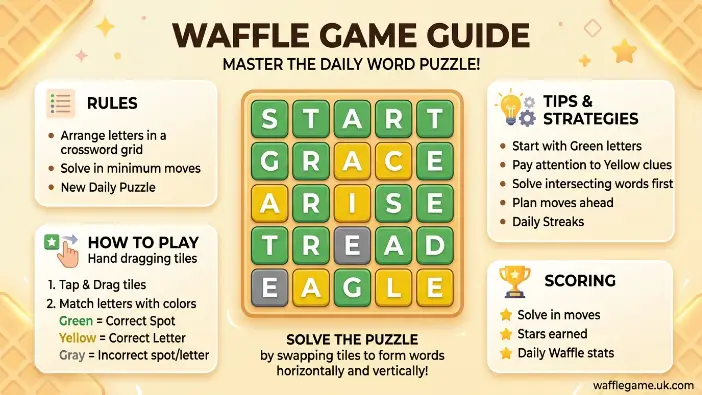
To play the Waffle Game, you are given a grid of scrambled letters arranged in a waffle-shaped layout where each row and column forms a valid word. The goal is to rearrange the letters into the correct positions by swapping them strategically within a limited number of moves. Start by identifying obvious letter placements and partially correct words, then use logic to determine which letters belong in each row and column. Every swap affects two words at once, so careful planning is important. You win the game when all horizontal and vertical words are correctly completed within the allowed moves.
Understanding the Waffle Grid Layout
The Waffle grid layout is designed in a structured shape where letters are arranged to form multiple horizontal and vertical words at the same time. Unlike traditional word puzzles, the grid already contains all the correct letters, but they are placed in incorrect positions. The layout usually resembles a compact waffle-like structure, making it visually distinct and easy to follow. Each row and column intersects with others, which means every letter plays a dual role in forming two different words. This interconnected design is what makes the puzzle both challenging and engaging for players of all skill levels.
In this layout, players must constantly analyze both directions before making any move. A single letter swap can change the outcome of two words simultaneously, so understanding the full grid is essential. The structure encourages players to look for patterns, common letter combinations, and possible word endings. By studying the layout carefully, players can quickly identify which letters are misplaced and which ones are already correctly positioned. This understanding forms the foundation for solving the entire Waffle puzzle efficiently and accurately.
Basic Rules of Letter Swapping
The basic rule of the Waffle Game is simple: players can only swap two letters at a time to rearrange the grid into correct words. Each swap affects both a horizontal and a vertical word simultaneously, which adds a layer of strategy to every move. Players cannot move letters freely; they must choose two positions and exchange them. This limitation is what makes the puzzle more challenging and encourages careful thinking before acting. Every move counts, so random swapping is not an effective strategy for solving the puzzle successfully.
In addition to swapping rules, players must also complete the puzzle within a limited number of moves. The game provides feedback by showing which letters are correctly placed and which are not, helping players adjust their strategy. Since each swap influences multiple words, understanding letter relationships is important. Players who observe patterns and plan are more likely to solve the puzzle efficiently. These simple yet strategic rules make the Waffle Game both engaging and mentally stimulating for word puzzle lovers.
Step-by-Step Gameplay Instructions
To start playing the Waffle Game, first carefully observe the entire grid and identify any obvious letter placements or partially formed words. Begin by focusing on rows or columns that already look close to correct. Next, select two letters and swap them to see how they affect both intersecting words. Continue analyzing the grid after each move, adjusting your strategy based on the new letter positions. The key is to always think about how one swap impacts the entire structure rather than focusing on a single word at a time.
As you progress, gradually build correct words by using logic and elimination. Look for common word patterns, such as prefixes or suffixes, to guide your decisions. Avoid unnecessary swaps, as each move is limited. Instead, prioritize moves that improve more than one word at a time. Keep refining the grid until all horizontal and vertical words are correctly formed. Following this step-by-step approach increases your chances of solving the puzzle efficiently and within the allowed number of moves.
Winning Conditions Explained
The winning condition in the Waffle Game is achieved when all horizontal and vertical words in the grid are correctly completed. This means every letter must be in its exact proper position, forming valid words in both directions. The puzzle is considered solved only when there are no incorrect placements left in the grid. Players must reach this solution within the limited number of allowed swaps, making efficiency an important factor in winning the game.
In addition to completing all words correctly, players are often rewarded based on how efficiently they solve the puzzle. Fewer moves typically indicate better performance and stronger strategic thinking. If the grid is fully correct but the move limit is exceeded, the result may still be considered less optimal depending on the game rules. Therefore, winning is not just about completing the puzzle, but also about solving it smartly within constraints. This makes the Waffle Game both challenging and rewarding for consistent players.
Waffle Game Mechanics Explained
Waffle Game mechanics are based on a structured letter-swapping system where players rearrange pre-filled letters in a grid to form correct words both horizontally and vertically. Each letter is initially placed in the wrong position, and the player must fix the entire puzzle by exchanging two letters at a time. Every swap impacts two intersecting words, making each move strategically important. The game provides visual feedback by highlighting correct placements, helping players track progress. With a limited number of moves allowed, players must carefully plan each action, focusing on logic, patterns, and word structure to complete the puzzle efficiently and accurately.
Letter positioning system (correct vs incorrect)
The letter positioning system in the Waffle Game is designed to show players which letters are correctly placed and which ones need to be moved. At the start of the puzzle, all letters are already in the grid but arranged incorrectly. Players must identify the correct position of each letter by analyzing both horizontal and vertical word formations. When a letter is in its right place, it contributes correctly to both intersecting words, helping the player move closer to solving the puzzle. This system encourages logical thinking and careful observation rather than random guessing or unnecessary moves.
As players continue swapping letters, the system continuously updates the grid to reflect progress. Incorrect letters remain movable until they are placed in the correct position. This dynamic setup helps players understand how each letter interacts with others in the grid. It also builds a sense of progression as more letters become correctly positioned. The positioning system is essential because it guides players toward solving the puzzle efficiently by showing clear differences between correct and incorrect placements.
Color indicators and feedback system
The color indicators in the Waffle Game provide essential feedback to help players understand their progress. Typically, correct letters are highlighted in a distinct color, showing that they are in the right position within both horizontal and vertical words. Incorrect or misplaced letters remain in a neutral state, signaling that they still need to be adjusted. This visual system allows players to quickly identify which parts of the puzzle are solved and which areas require further attention without guessing blindly.
The feedback system updates instantly after every swap, making the gameplay interactive and responsive. Players can immediately see how their moves affect the overall grid structure. This helps in building better strategies and avoiding repeated mistakes. The combination of color cues and real-time feedback ensures that players stay engaged and focused on logical solving. It also makes the puzzle more intuitive, especially for beginners who rely on visual guidance to understand word placement patterns effectively.
Move limits and puzzle structure.
The Waffle Game is designed with a limited number of moves, which adds a layer of challenge and strategy to the gameplay. Players cannot swap letters endlessly; instead, they must complete the puzzle within a set number of allowed moves. This limitation forces users to think carefully before making each swap, as every action directly affects their chances of winning. Efficient planning becomes essential, and random guessing is discouraged because it can quickly consume available moves.
The puzzle structure itself is built in a way that each swap impacts two words simultaneously, increasing the importance of each decision. Players must balance between solving individual words and considering the entire grid. This interconnected structure, combined with move limits, creates a more strategic experience compared to simple word games. Success depends not only on vocabulary skills but also on logical reasoning, pattern recognition, and careful move management throughout the game.
Best Strategies and Tips to Win Waffle Game
To win the Waffle Game, the best strategy is to start by identifying letters that are already close to their correct positions and focus on completing easier words first. Look for common patterns, prefixes, and suffixes to guide your swaps instead of making random moves. Since each swap affects two words, always think about the overall grid before acting. Try to lock confirmed letters early so they don’t move again unnecessarily. Work from the corner and edge letters toward the center, and use elimination to narrow possibilities. Careful planning, pattern recognition, and minimizing unnecessary swaps are key to solving the puzzle efficiently.
Beginner-friendly tips
Blog For beginners, the Waffle Game becomes much easier when you start by focusing on the corner letters first. These letters often connect multiple words, so identifying their correct positions early can quickly reduce confusion in the grid. Instead of making random moves, carefully observe which letters already seem close to forming valid words. This helps you build a strong starting point and improves overall accuracy while solving the puzzle step by step.
Another useful beginner tip is to identify fixed or common patterns early in the game. Look for familiar word endings like “-ing,” “-ed,” or “-tion,” as well as common prefixes. Recognizing these patterns helps you predict where certain letters should go. By focusing on structure rather than guessing, beginners can solve puzzles more efficiently and avoid wasting moves on unnecessary swaps.
- Focus on corner letters first: Corner letters are more important because they connect both horizontal and vertical words. Correctly placing them early helps unlock multiple parts of the grid and reduces confusion in later moves.
- Identify fixed patterns early: Look for common word structures like prefixes, suffixes, or repeated letter combinations. Spotting these patterns quickly helps you predict correct placements and solve the puzzle more efficiently with fewer mistakes.
Advanced solving strategies
Advanced players in the Waffle Game often rely on working from confirmed letters first. Once a letter is correctly placed and locked, it should be used as a reference point to build surrounding words. This method reduces uncertainty and allows players to solve interconnected words more efficiently. By focusing on stable letters, you can gradually complete the grid with fewer mistakes and better accuracy.
Another powerful strategy is using the elimination technique. Instead of guessing where a letter might fit, players eliminate impossible positions based on already formed words. This logical approach significantly reduces confusion and helps narrow down correct placements faster. Advanced players combine this with pattern recognition to solve puzzles in fewer moves, making their gameplay more strategic and consistent.
- Work from confirmed letters: Start with letters that are already correctly placed and treat them as fixed anchors. Build surrounding words based on these confirmed positions to reduce errors and improve solving speed.
- Use elimination technique: Rule out impossible letter positions by analyzing both horizontal and vertical word patterns. Gradually narrow down options until the correct placement becomes clear, making the solving process more logical and efficient.
Common mistakes to avoid
One of the most common mistakes in the Waffle Game is making random swaps without any clear strategy. Many players try to move letters quickly without analyzing the full grid, which often leads to wasted moves and confusion. Since each swap affects two words, random actions can make the puzzle harder instead of easier. A thoughtful approach is always more effective than rushing through the game.
Another frequent mistake is ignoring partial matches within words. Some players overlook letters that are already correctly placed in one direction but incorrect in another. This leads to unnecessary changes that disrupt progress. Paying attention to partial matches helps maintain progress and prevents breaking already correct parts of the puzzle. Careful observation and patience are essential to avoid these common errors.
- Random swapping without strategy: Making moves without analyzing the grid wastes limited attempts and often disrupts already correct placements, making the puzzle harder to solve.
- Ignoring partial matches: Overlooking letters that are correct in one direction but wrong in another leads to unnecessary changes and slows down progress in completing the full grid.
Waffle Game vs Other NYT Games
Waffle Game differs from other New York Times-style games in both structure and gameplay. Unlike Wordle, which focuses on guessing a single hidden word, Waffle requires players to rearrange multiple words simultaneously within a single grid. Compared to Spelling Bee, which emphasizes creating as many words as possible from given letters, Waffle is more about logic and placement accuracy. In contrast to Connections, which groups words by themes, Waffle is purely focused on letter positioning and pattern recognition. This makes Waffle more strategic and structured, appealing to players who enjoy solving interconnected puzzles with careful planning and minimal guesswork daily.
Waffle vs Wordle
Waffle and Wordle are both popular word games, but their gameplay styles are very different. Wordle focuses on guessing a single hidden five-letter word within a limited number of attempts, using color-coded feedback to guide players. In contrast, Waffle gives players all the letters upfront but in the wrong positions, and the challenge is to rearrange them correctly into multiple words. This makes Waffle more about logic and structure rather than guessing hidden words.
Another key difference is strategy and thinking style. Wordle relies on vocabulary knowledge and elimination through guesses, while Waffle requires analyzing the entire grid at once. Each move in Waffle affects multiple words simultaneously, making it more complex and interconnected. Wordle is simpler and faster, but Waffle offers a deeper puzzle experience that rewards planning and careful decision-making.
Waffle vs Spelling Bee
Waffle and Spelling Bee both come from the New York Times puzzle ecosystem, but they test different skills. Spelling Bee challenges players to form as many words as possible using a set of seven letters, with one required central letter. It focuses heavily on vocabulary expansion and word discovery. On the other hand, Waffle provides a fixed grid where all letters are already present, and players must rearrange them into correct words.
The gameplay experience is also quite different. Spelling Bee is more open-ended, allowing multiple possible answers, while Waffle has a single correct solution for each puzzle. Waffle emphasizes logical placement and structure, whereas Spelling Bee rewards creativity and word knowledge. Both are engaging, but Waffle is more puzzle-oriented while Spelling Bee is more word-generation focused.
Waffle vs Connections
Waffle and Connections differ greatly in their core mechanics and objectives. Connections is a puzzle where players group words based on hidden themes or categories. It requires identifying relationships between words rather than focusing on spelling or placement. In contrast, Waffle is entirely based on rearranging letters into correct word positions within a structured grid, making it more about spatial logic and word formation.
The thinking approach in both games is also distinct. Connections demands abstract reasoning and pattern recognition across groups of words, while Waffle requires step-by-step logical swaps to complete a fixed solution. Connections can have multiple ways to interpret categories, but Waffle has only one correct arrangement. This makes Connections more interpretive and Waffle more structured and deterministic in nature.
Why Waffle Game is So Popular
Waffle Game is so popular because it offers a perfect balance of simplicity and mental challenge, making it enjoyable for both beginners and experienced puzzle players. Unlike many word games, it provides all letters upfront, so players focus on logic and strategy instead of guessing. Its daily puzzle format keeps users engaged and encourages consistent play. The game also improves vocabulary, pattern recognition, and problem-solving skills, which adds educational value. Quick gameplay sessions make it ideal for short breaks, while the satisfying feeling of solving interconnected words keeps players coming back for more engaging and rewarding daily challenges.
Brain training and cognitive benefits
The Waffle Game provides strong brain training benefits by encouraging players to think logically and analyze patterns. Since every move affects multiple words at once, players must carefully evaluate each decision before swapping letters. This improves critical thinking skills and strengthens problem-solving abilities over time. It also enhances vocabulary knowledge because players are constantly exposed to different word structures and combinations.
In addition to logical thinking, the game also boosts memory and concentration. Players need to remember letter positions and track changes throughout the puzzle, which helps improve short-term memory skills. Regular practice can sharpen mental agility and make it easier to recognize word patterns quickly. This combination of vocabulary learning and cognitive exercise makes Waffle both fun and educational for daily brain training.
Daily challenge and engagement factor
One of the main reasons for Waffle’s popularity is its daily challenge format. Players receive a new puzzle every day, which keeps the experience fresh and exciting. This routine encourages users to return regularly, making it a part of their daily habit. The limited number of moves also adds pressure, increasing engagement and making each puzzle feel more rewarding to complete.
The game is designed for short but meaningful play sessions, which fit perfectly into busy schedules. Players can complete a puzzle in just a few minutes, yet still feel mentally stimulated. This balance between quick gameplay and challenging structure keeps users engaged without feeling overwhelmed. The daily reset feature also creates anticipation, motivating players to return and improve their performance each day.
Appeal among word puzzle lovers
Waffle is especially appealing to word puzzle lovers because it combines logic, vocabulary, and strategy in a single game. Unlike simple guessing games, it requires players to think deeply about word structure and letter placement. This makes it more engaging for those who enjoy solving complex puzzles rather than just finding quick answers. The satisfaction of completing a fully structured grid adds to its charm.
Word game enthusiasts also appreciate the uniqueness of Waffle’s mechanics. The interconnected word system creates a more challenging and rewarding experience compared to traditional word puzzles. Each solved grid feels like a complete achievement, especially when completed in fewer moves. This blend of challenge and satisfaction makes Waffle a favorite among dedicated fans of brain-teasing word games.
Related Keywords & LSI Usage in Gameplay Context
Waffle Game is commonly associated with several related keywords and LSI terms that help users find guides, tips, and gameplay strategies online. Popular search phrases include “Waffle puzzle tips,” “NYT word games strategy,” “daily word puzzle games,” and “best word game apps.” These keywords reflect the growing interest in structured word challenges that combine logic and vocabulary skills. In gameplay context, they are used to explore solving techniques, improve performance, and understand game mechanics better. By targeting these LSI keywords, content becomes more discoverable and relevant for players searching for effective ways to master the Waffle Game.
- Waffle puzzle tips: Practical strategies and techniques used to solve the Waffle Game more efficiently, such as focusing on corner letters, recognizing patterns, and minimizing unnecessary swaps.
- NYT word games strategy: General methods used across New York Times-style word games to improve performance, including logical thinking, elimination techniques, and pattern recognition skills.
- Daily word puzzle games: A category of games that offer a new puzzle every day, encouraging consistent play, habit building, and gradual improvement in vocabulary and problem-solving abilities.
- Best word game apps: Popular mobile or web-based applications designed to enhance vocabulary and brain training through interactive word challenges, puzzles, and strategic gameplay experiences.
Frequently Asked Questions
What is the Waffle Game in the NYT?
The Waffle Game is a daily word puzzle where players rearrange scrambled letters in a grid to form correct horizontal and vertical words using strategic swaps.
Is Waffle free to play?
Yes, the Waffle Game is generally free to play through online puzzle platforms and does not require any paid subscription in most cases.
How many moves are allowed in Waffle?
Each puzzle comes with a limited number of moves, and players must solve the entire grid within those moves to complete the challenge successfully.
Is Waffle harder than Wordle?
Many players find Waffle more challenging than Wordle because it involves solving multiple interconnected words instead of guessing a single hidden word.
What skills does Waffle improve?
Waffle helps improve vocabulary, logical thinking, pattern recognition, and problem-solving skills through its structured word grid gameplay.
Conclusion
Waffle Game New York Times is a highly engaging word puzzle that combines logic, vocabulary, and strategic thinking in a unique grid-based format. Unlike traditional guessing games, it challenges players to rearrange all given letters into correct words with careful planning and limited moves, making every decision important.
With its daily puzzle format, simple rules, and deep strategic gameplay, Waffle keeps players mentally active and consistently entertained. It is not only a fun pastime but also a great way to improve cognitive skills and word knowledge. For anyone who enjoys brain-teasing challenges, Waffle is a rewarding and addictive choice.