
Waffle daily word game is a popular online word puzzle that challenges players to rearrange scrambled letters into correct words within a waffle-shaped grid. Each day brings a new puzzle, requiring logic, pattern recognition, and careful planning rather than random guessing. Its simple design and addictive gameplay have made it a favorite among word game enthusiasts worldwide.
Because the game updates daily, many players become interested in revisiting earlier challenges through the Waffle daily word game archive. This archive concept helps players understand past puzzles, study word patterns, and improve their solving strategies. Even though official access to older puzzles may be limited, the idea of an archive remains valuable for learning, practice, and mastering the game over time.
What Is the Waffle Word Game?
Waffle Word Game is a daily online word puzzle that challenges players to rearrange scrambled letters into correct words within a waffle-shaped grid. Unlike simple guessing games, it requires logical thinking, pattern recognition, and careful planning to solve all words in the fewest possible moves. Each puzzle is designed with interconnected horizontal and vertical words, making every letter placement important. The game resets daily, giving players a fresh challenge every 24 hours. Because of its structured design and satisfying solving process, the waffle word game has become a popular choice for users who enjoy brain training and word-based puzzles.
Basic Concept of Waffle Puzzle
The basic concept of the waffle word game revolves around a grid filled with scrambled letters that must be swapped into their correct positions. The grid is shaped like a waffle, with words running both horizontally and vertically, creating overlapping connections. Players must use these intersections to guide their decisions and gradually form valid English words. Each correct placement helps unlock other parts of the puzzle, making it a step-by-step reasoning challenge rather than a random guessing game. The fewer moves a player uses, the better their final score, encouraging efficient and strategic thinking.
In addition, the puzzle design ensures that every letter has a fixed correct position, so success depends on logic rather than luck. Players often start by identifying obvious word patterns or correctly placed letters, then build around them. This creates a satisfying problem-solving experience where each move brings the player closer to completion. Over time, regular practice with the waffle word game improves vocabulary recognition and mental agility.
Game Rules Explained Simply
The rules of the waffle word game are simple but require thoughtful execution. Players are given a scrambled grid of letters and must swap them to form correct words both horizontally and vertically. Each swap counts as a move, and the goal is to complete the puzzle using the fewest possible moves within the allowed limit. A word is only considered correct when all its letters are in the right positions, meaning every move should be carefully planned.
Although the rules are easy to understand, mastering the game takes practice. Players need to analyze how each letter swap affects multiple words at once, since every change impacts both directions of the grid. Random swapping usually leads to inefficient progress, so strategic thinking is essential. Over time, players develop better pattern recognition and start predicting correct placements more accurately, making the waffle word game both challenging and rewarding.
Difference Between Waffle and Other Word Games (Wordle, etc.)
The waffle word game differs significantly from other popular word games like Wordle because it focuses on rearranging known letters instead of guessing hidden words. In Wordle, players try to discover a single word through clues, but in Waffle, all letters are already visible, and the challenge lies in placing them correctly. This makes Waffle more of a logic and pattern puzzle rather than a deduction-based guessing game.
Another key difference is the structure of gameplay. While Wordle gives a linear guessing experience, the waffle word game uses an interconnected grid where each swap affects multiple words at once. This creates a more complex and strategic environment, requiring players to think in multiple directions simultaneously. As a result, Waffle appeals more to players who enjoy spatial reasoning and structured problem-solving rather than pure word guessing.
Read Also: pancake or waffle game
Understanding the Waffle Daily Puzzle System
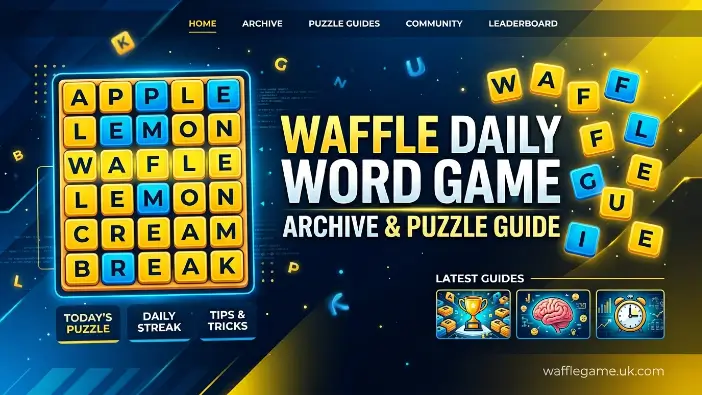
The waffle word game follows a structured daily puzzle system where every player receives the same challenge each day. The puzzle consists of a fixed grid of scrambled letters that must be rearranged into correct words by swapping tiles. Each move affects multiple words simultaneously, so players must think carefully before making changes. The goal is to complete the entire grid using the minimum number of swaps. This daily system keeps the game engaging, competitive, and mentally stimulating, encouraging players to return every day to test their logic and pattern recognition skills.
How Daily Puzzles Work
The waffle word game daily puzzle is designed so that all letters are already present in the grid, but in incorrect positions. Players must identify correct placements by swapping letters between intersecting words. Since each letter belongs to both a horizontal and vertical word, every move influences more than one solution path. This makes the puzzle more strategic than simple guessing games, requiring careful observation and logical reasoning.
In addition, each completed puzzle rewards efficiency rather than speed alone. The fewer swaps a player uses, the better their performance. This structure encourages thoughtful decision-making and helps players gradually improve their problem-solving skills as they practice the waffle word game daily.
Reset Time and Puzzle Rotation
The waffle word game resets once every 24 hours, offering a brand-new puzzle each day. All players worldwide receive the same puzzle during that cycle, which creates a shared global experience. Once the day changes, the previous puzzle is no longer available in the official interface, encouraging users to complete it before the reset.
The rotation system ensures continuous engagement by preventing repetition. Each puzzle is uniquely generated, so no two days feel the same. This consistent refresh keeps the waffle word game exciting and motivates players to return daily to solve new challenges and compare their performance over time.
Difficulty Progression Patterns
The waffle word game does not explicitly label difficulty levels, but players often notice subtle progression patterns. Early parts of a puzzle may contain more obvious letter placements, while later stages require deeper analysis and careful swapping. The complexity comes from how letters interact across multiple intersecting words, making some configurations harder to resolve than others.
Over time, players develop strategies to handle these patterns more efficiently. Experienced users can quickly identify anchors and predictable word structures, reducing the number of moves needed. As a result, the waffle word game feels progressively easier with practice, even though the underlying difficulty varies from puzzle to puzzle.
Waffle Daily Word Game Archive Explained
The Waffle word game archive refers to the collection or record of past daily puzzles from the Waffle word game. Since the game is released in a daily format, each puzzle is unique and typically available for only 24 hours. The archive concept helps players understand previous challenges, revisit older puzzles, and study how different letter arrangements were solved. Although not always officially supported, the idea of an archive has become important for players who want to improve their skills and track puzzle patterns over time. It acts as a learning resource for consistent practice.
What Is the Archive?
The waffle word game archive is essentially a stored record of previous daily puzzles that players can review or study. In many cases, the official game only provides the current day’s puzzle, meaning older ones disappear after the reset. However, the archive concept allows players to imagine or access a history of puzzles either through external tools, community collections, or saved game data. This makes it easier to analyze past patterns and improve solving techniques.
In practical terms, the archive serves as a reference point for learning rather than just replaying games. Players often use it to revisit difficult puzzles they could not solve earlier. By studying these past configurations, they can better understand word patterns, improve their logic, and become more efficient in future attempts at the waffle word game archive challenges.
Why Players Search for Past Puzzles
Many players look for the waffle word game archive because it helps them improve their overall performance. Revisiting past puzzles allows users to understand where they made mistakes and how they could have solved the grid more efficiently. It also provides a chance to practice different word combinations that may not appear frequently in daily challenges.
Another reason players search for archives is curiosity and skill tracking. Some enjoy comparing their solving speed and move count across different days. Others simply want to replay particularly difficult puzzles. This makes the archive a valuable learning tool that supports long-term improvement in the waffle word game archive experience.
How Archive Tracking Works (Unofficial vs Official Access)
The waffle word game archive is not always officially available within the game itself, which leads players to rely on alternative methods. Official access, when available, is usually limited and may only show the current puzzle without historical data. This means players cannot directly replay older puzzles through the main interface in many versions.
On the other hand, unofficial access includes community-created archives, third-party websites, or personal records such as screenshots and saved game logs. These methods allow users to track and revisit past puzzles, although they may not always be complete or fully accurate. Despite limitations, they remain useful for players who want to study patterns and improve their performance in the Waffle Word Game Archive System.
Limitations of Waffle Archives
The waffle word game archive has several limitations that affect how useful it can be for players. One
major issue with the blog is the lack of official long-term storage in many versions of the game. Without built-in archive support, players must rely on external sources, which may not always be reliable or complete. This can lead to missing puzzles or inconsistent data across different platforms.
Another limitation is accuracy and accessibility. Unofficial archives may contain errors, incomplete solutions, or outdated information. Additionally, some puzzles may never be recorded at all, making it impossible to revisit every challenge. Despite these drawbacks, the waffle word game archive still provides valuable learning opportunities for players who want to analyze past gameplay and improve their solving strategies over time.
How to Access Past Waffle Puzzles
Accessing the waffle word game archive is not always straightforward because the game is primarily designed around a daily puzzle system. Each puzzle is available for only 24 hours, and once it resets, the previous game is often no longer directly accessible in the official interface. This creates a challenge for players who want to revisit older puzzles for practice or analysis. However, there are still several ways to explore past challenges, including unofficial tools, saved data, and browser-based methods that help preserve puzzle history for learning and improvement purposes.
Official Game Availability
In most versions, the waffle word game archive is not fully supported within the official game itself. Players are usually given access only to the current daily puzzle, and once the day ends, the interface moves on to the next challenge. This design encourages daily engagement but limits the ability to replay older puzzles directly through the game.
As a result, official access to past puzzles is minimal or non-existent in many cases. Some versions may offer limited stats or completion records, but they rarely include full puzzle replays. This means players who rely solely on the official platform have very limited access to the full Waffle Word Game archive experience.
Third-Party Archive Tools
Third-party tools have become a popular way to access the Waffle Word Game archive. These platforms are often created by the community and aim to store daily puzzles, solutions, and historical data. They allow players to revisit older challenges and practice solving different grid patterns that may no longer be available in the official game.
However, these tools vary in quality and reliability. Some archives are well-maintained and regularly updated, while others may have missing days or incorrect solutions. Despite these inconsistencies, they remain a useful option for players who want a broader waffle word game archive experience beyond the limitations of the official platform.
Browser History & Saved Games
Another simple method to access the waffle word game archive is through browser history. Since the game is played online, each daily puzzle has a unique URL or session that may still be accessible if it has been saved in browsing history. Players can revisit these links to reopen previously played puzzles, depending on how the website stores session data.
In addition, many players manually save their progress using screenshots or notes. This allows them to review past puzzles even if the original game is no longer accessible. While not a true archive system, this method provides a practical way to build a personal waffle word game archive for study and improvement over time.
Best Strategies to Solve Waffle Puzzles Faster
Improving your performance in the waffle word game archive depends heavily on using the right solving strategies rather than relying on random swaps. Since each puzzle is built on interconnected horizontal and vertical words, every move affects multiple parts of the grid. This makes planning essential for faster completion. Players who approach the puzzle systematically tend to solve it in fewer moves and with better accuracy. By focusing on structure, patterns, and logical positioning, you can significantly improve your efficiency and consistently achieve better results in the Waffle Word Game Archive challenges.
Start from Fixed Letters First
One of the most effective techniques in the waffle word game archive is identifying fixed or correctly placed letters at the beginning. These letters act as anchors and help you build surrounding words with more confidence. Instead of randomly swapping tiles, focusing on stable positions reduces confusion and provides a clear starting point for solving the puzzle.
Once fixed letters are identified, players can gradually expand outward by connecting nearby letters. This structured approach minimizes unnecessary moves and helps maintain order in the grid. Over time, this method trains your brain to recognize correct placements faster, improving overall performance in the waffle word game archive and making future puzzles easier to solve.
Identify Word Patterns
Pattern recognition plays a crucial role in the waffle word game archive because many words follow familiar structures. Recognizing common prefixes, suffixes, and letter combinations allows players to quickly guess possible word formations. This reduces trial-and-error and speeds up the solving process significantly.
As you gain experience, you begin to notice repeated word structures across different puzzles. These patterns help you anticipate correct placements before making a move. By combining logic with vocabulary awareness, you can solve grids more efficiently and improve consistency in the waffle word game archive, especially in more complex puzzles.
Work from Corner Connections
Corners in the waffle word game archive are often the most important starting points because they connect multiple words at once. Solving corner positions first helps establish a strong foundation for the rest of the grid. Since these letters influence both horizontal and vertical words, correct placement in corners reduces overall complexity.
Working from corners also helps narrow down possible word combinations quickly. Once a corner is solved, it becomes easier to identify surrounding letters and complete adjacent words. This method improves accuracy and reduces unnecessary swaps, making it a powerful strategy for mastering the waffle word game archive efficiently.
Avoid Random Swapping
Random swapping is one of the biggest mistakes players make in the waffle word game archive. While it may seem like a quick way to explore possibilities, it often leads to confusion and wasted moves. Since every swap affects multiple words, unplanned changes can disrupt already correct placements.
Instead of guessing, players should always evaluate the impact of each move. A planned approach ensures that every swap contributes toward solving the puzzle. By avoiding randomness and focusing on logic, you can significantly reduce errors and improve your solving speed in the waffle word game archive, making each puzzle more efficient and enjoyable.
Common Mistakes Players Make
Many players struggle in the waffle word game archive, not because the puzzles are too difficult, but because they rely on inefficient solving habits. Since every move in the game affects multiple words at once, even small mistakes can quickly lead to confusion. Players often lose efficiency by rushing decisions instead of analyzing the grid carefully. Understanding these common mistakes is important because it helps improve overall performance and reduces unnecessary moves. By avoiding these errors, players can significantly enhance their solving speed and accuracy in the waffle word game archive challenges.
Ignoring Letter Placement Logic
One of the most common mistakes in the waffle word game archive is ignoring how letter placement affects both horizontal and vertical words. Many players focus only on forming a single word without considering how that placement impacts the entire grid. This often leads to broken word structures and repeated corrections.
When players fail to understand placement logic, they end up making moves that seem correct individually but disrupt the overall puzzle. Since every letter belongs to two intersecting words, ignoring this connection slows progress significantly. Developing awareness of placement relationships is essential for success in the waffle word game archive.
Over-Swapping Without Planning
Another frequent error in the waffle word game archive is over-swapping without a clear strategy. Players sometimes try multiple random swaps in hopes of finding the correct arrangement. However, this usually wastes moves and makes the puzzle harder to solve.
Each unnecessary swap increases complexity instead of reducing it. Without planning, players lose track of which letters were previously correct. A better approach is to evaluate each move carefully before executing it. Strategic swapping helps maintain structure and improves efficiency in the waffle word game archive, leading to faster and more accurate solutions.
Not Using Pattern Recognition
Failing to use pattern recognition is another major mistake in the waffle word game archive. Many players overlook familiar word structures such as prefixes, suffixes, or common letter pairings. This slows down their ability to identify correct word formations.
Pattern recognition allows players to predict possible word arrangements quickly instead of relying on trial and error. Without this skill, solving becomes more time-consuming and less efficient. By training themselves to recognize recurring patterns, players can greatly improve their performance in the Waffle Word Game Archive and solve puzzles with fewer moves and less effort.
Why Waffle Word Game Is So Popular
The popularity of the waffle word game archive and the game itself comes from its simple yet highly engaging design. Unlike many complex puzzle games, it offers an easy-to-understand format that still challenges the brain in meaningful ways. Players enjoy the satisfaction of solving interconnected word grids using logic and strategy rather than guessing. This balance between simplicity and mental challenge makes it appealing to a wide audience, from casual gamers to word puzzle enthusiasts. Its daily format and rewarding gameplay loop keep users returning consistently, increasing its overall popularity worldwide.
Daily Challenge Appeal
One of the main reasons behind the popularity of the waffle word game archive is its daily challenge format. Every day, players receive a new puzzle, which creates a habit-forming experience and encourages consistent engagement. This limited-time availability adds excitement and urgency, motivating users to solve the puzzle before it resets.
The daily challenge also ensures that players never get bored, as each puzzle offers a fresh arrangement of letters and unique difficulty levels. This constant variation keeps the experience dynamic and enjoyable. As a result, the waffle word game archive concept becomes even more appealing for those who enjoy tracking progress and improving over time.
Brain Training Benefits
The waffle word game archive is also popular because it offers strong cognitive benefits. Players must use logic, memory, and pattern recognition to solve each puzzle efficiently. This mental exercise helps improve vocabulary, focus, and problem-solving skills over time.
Regular engagement with the game strengthens the brain’s ability to recognize word structures quickly. It also encourages strategic thinking rather than random guessing. Because of these benefits, many users see the waffle word game archive not just as entertainment but also as a daily mental workout that supports long-term cognitive improvement.
Social Sharing Factor
Another key reason for the popularity of the waffle word game archive is its strong social sharing element. Players often share their daily results, move counts, and solving efficiency with friends or online communities. This creates a sense of competition and engagement beyond the game itself.
Sharing results also encourages players to improve their performance to match or beat others. This social aspect adds motivation and makes the experience more interactive. As a result, the waffle word game archive becomes part of a larger community-driven experience where players compare progress and celebrate achievements together.
Alternatives to Waffle Word Game
Players who enjoy the waffle word game archive often explore other word puzzle games that offer similar logic-based challenges but with different gameplay styles. These alternatives help keep the experience fresh while still improving vocabulary, pattern recognition, and problem-solving skills. Each game has its own unique structure, difficulty level, and daily engagement format. Whether you prefer guessing words, solving multiple grids, or finding as many words as possible, these alternatives provide excellent options for continuing your word puzzle journey beyond the Waffle Word Game archive experience.
- Wordle: A simple daily word puzzle where players guess a hidden five-letter word using color clues. It focuses on deduction and vocabulary skills rather than rearranging letters.
- Quordle A more advanced version of Wordle, where players solve four words at the same time. It requires strong multitasking and strategic guessing skills.
- Octordle is an even more challenging variation where players must solve eight word puzzles simultaneously, increasing complexity and mental pressure significantly.
- Spelling Bee-style games. These games challenge players to form as many words as possible from a set of given letters, focusing on creativity, vocabulary depth, and word discovery skills.
Frequently Asked Questions
What is the Waffle daily word game archive?
The waffle word game archive refers to a collection or record of past daily Waffle puzzles. It allows players to revisit older challenges, study letter patterns, and improve their solving strategies. While the official game often focuses only on the current daily puzzle, the archive concept is widely used by players who want to practice and analyze previous games for better performance.
Can I replay old Waffle puzzles?
In most official versions, you cannot directly replay past puzzles because the game is designed around a daily reset system. However, some unofficial tools, community archives, or saved browser data may help players access older puzzles. These methods are commonly used to build a personal waffle word game archive for practice.
Why do players use Waffle archives?
Players use the waffle word game archive to improve their skills, understand word patterns, and reduce solving time. Revisiting past puzzles helps identify mistakes and develop better strategies. It also provides extra practice for difficult puzzle types that may not appear frequently in daily challenges.
Is there an official archive for Waffle puzzles?
Most versions of the game do not offer a full official archive. Players usually only get access to the current daily puzzle. Because of this limitation, many users rely on third-party sources or personal records to track previous puzzles in the waffle word game archive system.
How can I improve at Waffle faster?
To improve, focus on recognizing word patterns, avoid random swapping, and start with fixed or corner letters. Practicing regularly and reviewing past puzzles from the waffle word game archive can also help you develop faster and more accurate solving skills over time.
Conclusion
The waffle word game archive concept highlights how valuable past puzzles can be for learning, practice, and long-term improvement in word-based games. Even though the official game mainly focuses on daily challenges, players benefit greatly from revisiting older puzzles through unofficial methods, personal records, or pattern analysis. This helps build stronger problem-solving skills and a deeper understanding of how the game works.
Overall, the waffle word game archive is not just about replaying old puzzles; it is about improving strategy, recognizing patterns faster, and becoming more efficient with each attempt. By practicing consistently and applying smart techniques, players can enjoy the game more while steadily improving their performance over time.